Sunday, April 12, 2015

Campaign Week 2: Labour pulls ahead (slightly)

This week saw two major events on the campaign trail.  The Scottish party leaders attended not one, but two debates, hosted by STV (Tuesday) and BBC Scotland (Wednesday).  More on that later.

On Wednesday, we saw the biggest policy announcement of the campaign so far, as Labour leader Ed Miliband announced plans to end the controversial non-dom tax status.  In theory, this status is supposed to allow, for a fee, those who consider their true home to be outside of the UK to pay no tax on any income that has nothing to do with the UK (for example, moneys that are earned in Canada and stay there), though there are many people who live in the UK who probably shouldn't have this status.  While it is disputed whether or not it will bring in more money into the Treasury, the fairness argument has surely has resonated with voters.

Sunday, April 5, 2015

Week 1 of the 2015 Campaign

Over the last week, we saw the public react to Channel 4's Jeremy Paxman interviewing Ed Miliband and David Cameron.  Despite the initial excitement when the first two polls came out, we have seen a bit of an overall shift over the last seven days.
Average of polls released as of Saturday evening

Monday, March 30, 2015

Why a single poll cannot tell the story

Yesterday saw the release of the first two opinion polls since last week's leaders' programme on Sky News and Channel 4.  The first poll was conducted by YouGov and published in the Sunday Times.  It suggested that Labour had a four-point lead, which would give it a choice in terms of who it could turn to in order to govern.

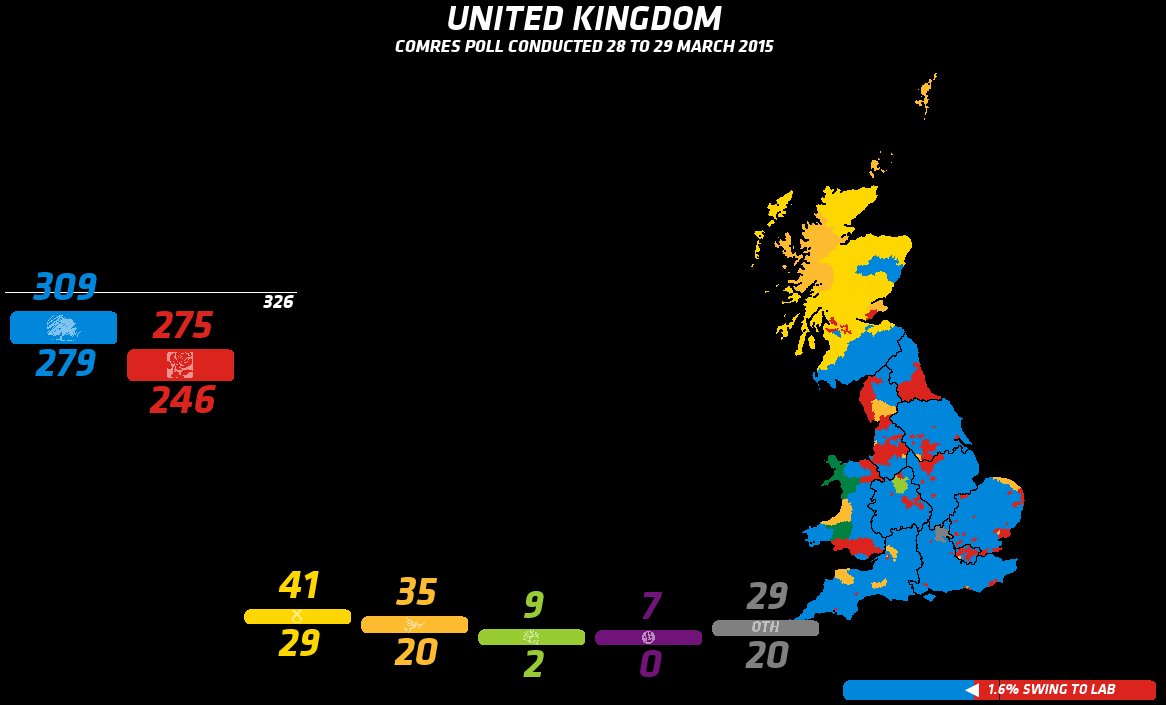
Later that evening, a second poll was released by the Daily Mail and ITV News conducted by Comres.  This poll showed a four-point lead for the Conservatives, which would give them a shot at forming another government.

Two polls, conducted around the same time, showing two different stories.

Sunday, March 29, 2015

Examining the trendlines with six weeks to go

And that's it.  Parliament has been prorogued for the final time, and will be formally dissolved tomorrow.  MPs are returning to their constituencies to do what needs to be done to keep their jobs.  Dubious promises will be made, tough questions will be dodged, and personal insults will be hurled.  But ultimately, 650 MPs will be allowed into Westminster to shape the next five years of the country's future.

The polls give us a snapshot of the national mood, but every poll will show that there are still a number of voters who haven't yet made up their minds.  But what about those who have either made up or otherwise changed their minds in recent months?  Where have they been going, and what will the House of Commons look like if it continues?

Sunday, March 22, 2015

Betting markets suggest second UK election possible in 2015

In the UK, you can place a bet on just about anything.  You can bet on the result of this afternoon's QPR-Everton match (Everton is the favourite as of this writing).  You can bet on who will replace Jeremy Clarkson as co-host of BBC's Top Gear (not sure whether 12/1 for Piers Morgan or 50/1 for Nigel Farage is more ridiculous).  You can bet on the winner of this year's Eurovision Song Contest (40/1 for the UK winning, meaning if I bet £1, I lose £1).

Of course, you can also bet on 7 May elections here in the UK.  You can bet on any possible outcome, including which party will finish with the most seats in the House of Commons, what kind of government will be formed, who will be leading that government, and the fate of the party leaders in their jobs both as leaders and as MPs.  You can even bet on who will win in each of the 650 constituencies, and it's the odds that bookmakers are offering on these kinds of bets that tell us the most about what to expect once the polls close in 45 days' time.

Sunday, March 8, 2015

The effect of Britain's new major parties

At the last general election in 2010, the three main parties had 88% of the vote.  That figure for the same three parties is now down to 72%, as three new parties have come to the forefront of British politics.

If the UK used a form of proportional representation, we would expect the UK Independence Party and the Green Party to have dozens of seats in the House of Commons.  However, with the first-past-the-post system that we have, neither of these parties is expected to get into the double digits on current projections.

Even though these representations of these two parties are expected to be tiny after the election, their uprisings are still having an impact on the balance of power across the UK.

Sunday, February 22, 2015

Why Labour is ahead of the Conservatives in seats, despite the polls being neck and neck

Opinion polls across the UK have shown the gap between the Labour and Conservative parties have narrowed to a couple of percentage points, with the consensus being a 2-point lead by Labour over the Tories.  Based on this, you would expect that the election will be close between the two parties with respect to the number of seats they are expected to win in the House of Commons.

When you extrapolate the polls to get a seat figure, however, Labour has a significant lead.  The lead is very similar to that which the Conservatives actually won in the 2010 general election, despite a seven-point victory in the popular vote.

Poll Average as of 13 February 2015: LAB 301; CON 259; SNP 53; LD 16; GRN 1; OTH 20

Conservative supporters say that the allocation of seats across the regions of the UK is biased towards Labour, whereas Labour supporters say that the Conservative vote is simply inefficient.  So who's right?  Let's take a look at the two theories.