Saturday, May 16, 2015

Three way race in Canada? Not quite...

We are now just over 150 days away from the next federal election, and the public opinion polls over the last week have shown the three major parties within just a couple of percentage points from each other when it comes to national support.
Weighted average of opinion polls over recent weeks appear to show a tight race
However, when you translate this into seats in parliament, a substantial difference begins to emerge.  The Liberals and NDP are close to each other, but the Conservatives are well ahead, though well short of being able to form another majority government.
Seat projection ranges based on recent opinion polls

So how do we explain the discrepancy between the opinion polls and the seat projection?

Friday, May 8, 2015

UK Election 2015: Polls, voting systems, and other thoughts

It was billed as the most unpredictable election in a generation, and it surely delivered.  Nobody expected the Conservatives to finish with a majority government.  Nobody expected Ed Balls to lose his seat.  Nobody expected the SNP to get quite as many seats as they did.  And nobody expected Labour to go backwards in terms of seats, even despite the goings-on in Scotland.

I could go on. But the point of the matter is that the polls are wrong.

Well, haven't we all got egg on our faces...

When this hit my screen, I had to take a double-take, as it just didn't make sense.
Hardly anyone believed the exit poll when it first came out.

All the opinion polls suggested that we'd have the most hung parliament in 40 years.  The suggestion that the Tories would be within striking distance of a majority government was, to say the least, surprising.  We even saw a pledge by Lord Ashdown to eat a hat on air if the poll was right.

Before the first result came in, we saw an online poll conducted by YouGov, asking voters how they voted.  That poll showed very little change between the two parties, so I (among numerous others) started considering that as the true indication of how the election went.

That's two elections in a row now where we were mistaken in disbelieving the exit poll.

Wednesday, May 6, 2015

Campaign Week 6: The final polls

That's it.  The campaign is over.  In just a few hours, the polls will be open, and in 24 hours, the new government will have been decided.  So what is the final call?

Friday, May 1, 2015

Campaign Week 5: It's Nearly Over (Maybe)

Seven days from now, the result of the election will be known.  Well, at least the technical part of how many seats each party has will be known.  What will be less clear is who will be running the country for the coming years (or months).

In the aftermath of the 2010 election, which produced the first hung parliament in 36 years, nobody knew what to do.  Though it took five days following the election to decide upon a prime minister, what made it easy is that one party, the Liberal Democrats, held the balance of power; they were able to effectively decide whether Gordon Brown or David Cameron would walk into Downing Street.
2010: Liberal Democrats hold balance of power

Compare that with the likely range of possibilities in this election, and things get a little more complicated, as we will have at least four parties with sizable enough representation to make a difference.
2015: Balance shared by SNP, Lib Dems, and possibly others

So if this is the result we can expect, how does that work in terms of the formation of a government?

Sunday, April 26, 2015

Campaign Week 4: No Consensus Among Pollsters

This election is going to be very difficult to predict.  We have three parties going from practical obscurity in 2010 to national prominence in this campaign, and it's very difficult to tell how spread out or concentrated their newfound support will be.

This alone makes coming up with a seat projection difficult enough.  What makes things even more challenging is the fact that polls are, quite simply, inconsistent with each other.

Sunday, April 19, 2015

Campaign Week 3: The Manifestos

Ah, manifesto week.  The week where we see all of the parties making pledges for the people of this country, telling us where the priorities for our very scarce resources lie.  It's a welcome, even if temporary, break from the usual mudslinging that goes on during the campaign.

So whose manifesto was most convincing to voters?  Well, it's a bit surprising what the pollsters are finding.

Sunday, April 12, 2015

Campaign Week 2: Labour pulls ahead (slightly)

This week saw two major events on the campaign trail.  The Scottish party leaders attended not one, but two debates, hosted by STV (Tuesday) and BBC Scotland (Wednesday).  More on that later.

On Wednesday, we saw the biggest policy announcement of the campaign so far, as Labour leader Ed Miliband announced plans to end the controversial non-dom tax status.  In theory, this status is supposed to allow, for a fee, those who consider their true home to be outside of the UK to pay no tax on any income that has nothing to do with the UK (for example, moneys that are earned in Canada and stay there), though there are many people who live in the UK who probably shouldn't have this status.  While it is disputed whether or not it will bring in more money into the Treasury, the fairness argument has surely has resonated with voters.

Sunday, April 5, 2015

Week 1 of the 2015 Campaign

Over the last week, we saw the public react to Channel 4's Jeremy Paxman interviewing Ed Miliband and David Cameron.  Despite the initial excitement when the first two polls came out, we have seen a bit of an overall shift over the last seven days.
Average of polls released as of Saturday evening

Monday, March 30, 2015

Why a single poll cannot tell the story

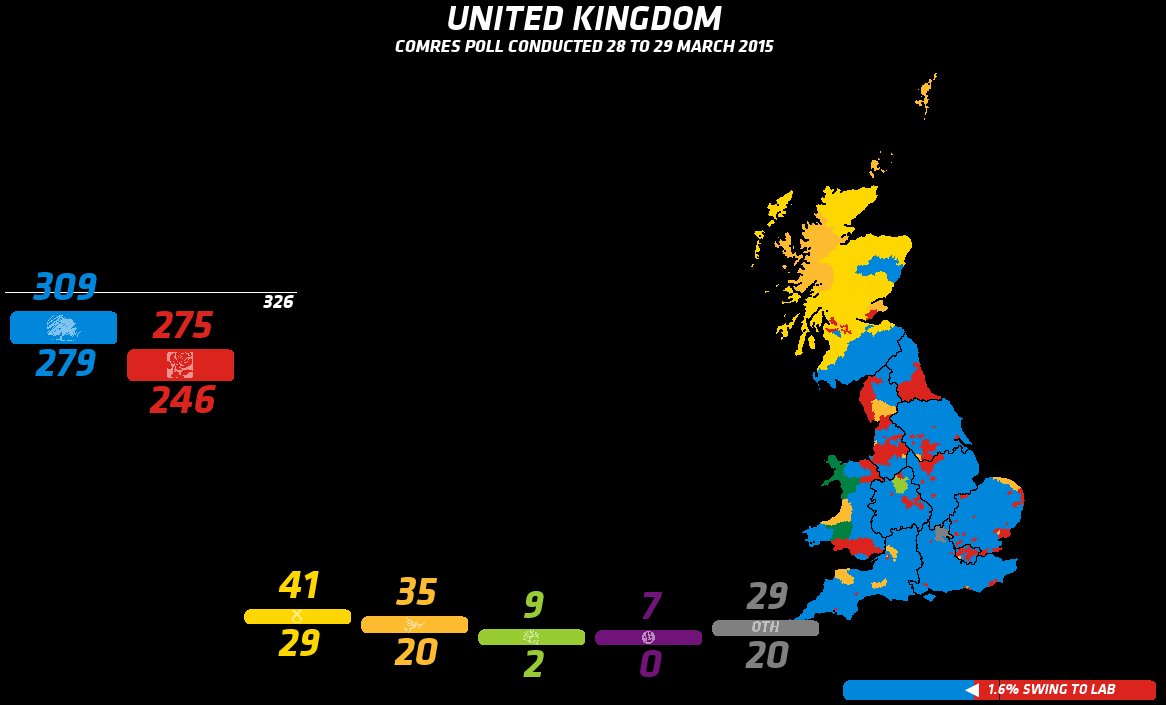
Yesterday saw the release of the first two opinion polls since last week's leaders' programme on Sky News and Channel 4.  The first poll was conducted by YouGov and published in the Sunday Times.  It suggested that Labour had a four-point lead, which would give it a choice in terms of who it could turn to in order to govern.

Later that evening, a second poll was released by the Daily Mail and ITV News conducted by Comres.  This poll showed a four-point lead for the Conservatives, which would give them a shot at forming another government.

Two polls, conducted around the same time, showing two different stories.

Sunday, March 29, 2015

Examining the trendlines with six weeks to go

And that's it.  Parliament has been prorogued for the final time, and will be formally dissolved tomorrow.  MPs are returning to their constituencies to do what needs to be done to keep their jobs.  Dubious promises will be made, tough questions will be dodged, and personal insults will be hurled.  But ultimately, 650 MPs will be allowed into Westminster to shape the next five years of the country's future.

The polls give us a snapshot of the national mood, but every poll will show that there are still a number of voters who haven't yet made up their minds.  But what about those who have either made up or otherwise changed their minds in recent months?  Where have they been going, and what will the House of Commons look like if it continues?

Sunday, March 22, 2015

Betting markets suggest second UK election possible in 2015

In the UK, you can place a bet on just about anything.  You can bet on the result of this afternoon's QPR-Everton match (Everton is the favourite as of this writing).  You can bet on who will replace Jeremy Clarkson as co-host of BBC's Top Gear (not sure whether 12/1 for Piers Morgan or 50/1 for Nigel Farage is more ridiculous).  You can bet on the winner of this year's Eurovision Song Contest (40/1 for the UK winning, meaning if I bet £1, I lose £1).

Of course, you can also bet on 7 May elections here in the UK.  You can bet on any possible outcome, including which party will finish with the most seats in the House of Commons, what kind of government will be formed, who will be leading that government, and the fate of the party leaders in their jobs both as leaders and as MPs.  You can even bet on who will win in each of the 650 constituencies, and it's the odds that bookmakers are offering on these kinds of bets that tell us the most about what to expect once the polls close in 45 days' time.

Sunday, March 8, 2015

The effect of Britain's new major parties

At the last general election in 2010, the three main parties had 88% of the vote.  That figure for the same three parties is now down to 72%, as three new parties have come to the forefront of British politics.

If the UK used a form of proportional representation, we would expect the UK Independence Party and the Green Party to have dozens of seats in the House of Commons.  However, with the first-past-the-post system that we have, neither of these parties is expected to get into the double digits on current projections.

Even though these representations of these two parties are expected to be tiny after the election, their uprisings are still having an impact on the balance of power across the UK.

Sunday, February 22, 2015

Why Labour is ahead of the Conservatives in seats, despite the polls being neck and neck

Opinion polls across the UK have shown the gap between the Labour and Conservative parties have narrowed to a couple of percentage points, with the consensus being a 2-point lead by Labour over the Tories.  Based on this, you would expect that the election will be close between the two parties with respect to the number of seats they are expected to win in the House of Commons.

When you extrapolate the polls to get a seat figure, however, Labour has a significant lead.  The lead is very similar to that which the Conservatives actually won in the 2010 general election, despite a seven-point victory in the popular vote.

Poll Average as of 13 February 2015: LAB 301; CON 259; SNP 53; LD 16; GRN 1; OTH 20

Conservative supporters say that the allocation of seats across the regions of the UK is biased towards Labour, whereas Labour supporters say that the Conservative vote is simply inefficient.  So who's right?  Let's take a look at the two theories.

Sunday, January 11, 2015

UK Election 2015: 17 weeks to go

After the 2010 general election resulted in a hung parliament and a coalition government, nobody thought that this parliament would still be governing.  But here we are, over 4½ years later, looking at proof that a coalition government can work.

But it's been painful.  Both parties have had to agree to things that they otherwise wouldn't in order to make the government work.  But in recent months, we have seen intra-government fighting in public like there hasn't been in a long time, as the Conservatives and Liberal Democrats try to form separate identities.

As we get closer to the election, I will be looking at where the polls are going, some of the trends developing, and try to develop an understanding of how each party got to where it did and how it can get to victory.

Sunday, October 19, 2014

UK Election 2015: 200 Days to Go

The party conferences have come to an end, the governing parties are fighting in public, and the political world realizes that, 200 days from today, the people of Britain will decide who will run the country for another five years.

As ever, there is no shortage of polling going on, as pollsters (as well as psephologists) try to predict the potential results and parties try to figure out what they need to do to win the keys to Number 10.  Based on the polls released up to today, the makeup of the House of Commons would result in a hung parliament for the second election in a row, the first time this has happened in over a century.

LAB 312; CON 256; SNP 42; LD 19; OTH 21
A party needs 326 seats to form a majority government.

This model is based on a uniform swing across each of the regions of Britain, which is not enough for UKIP to get any seats despite being third in the polls.  However, because of the variance of swings we see (as well as the margin of error of the polls themselves), the prospect of UKIP being shut out of Parliament next year is unlikely.  On balance of probabilities, the range of possibilities will look something like this:

LAB 290-316; CON 244-270; SNP 33-45; LD 18-31; UKIP 1-9

Why the minimum of 1 for UKIP despite them not even showing in the other visual?  Quite simply, I'm certain that UKIP will pick up at least one seat, but I couldn't tell you exactly which one.  Now, it's easy to say that I should easily be painting Clacton, as well as likely Rochester & Strood, purple as a result of recent and upcoming by-elections.  However, by-elections are full of anomolies, especially when caused by defections such as these, and voters will often think differently in a general election than in a by-election.  We therefore cannot know whether Douglas Carswell and Mark Reckless will hold onto their seats for UKIP in the general election.

Hung Parliament

This is the first time we have seen the prospect of a hung parliament since early 2012, and it only came about within the last couple of weeks.  Contrary to anything the Conservatives will try to tell you, it doesn't appear to be as a result of Ed Miliband's conference speech (the one where he forgot to mention the deficit); if it had, we would expect to see an uptick for the Tories, and this hasn't happened.


Labour's drop started happening in the aftermath of last month's independence referendum in Scotland.  Once the independence battle had been officially lost, the SNP moved towards campaigning for the so-called Westminster parties to uphold their promises on further devolution.  This led to a huge upswing in SNP support, and a phenomenal 19% swing from Labour to the SNP.  In fact, if you take out Scotland, Labour would likely have an overall majority (albeit a slim one).

LAB 299; CON 254; LD 17; OTH 21
Only 296 seats are needed for a majority when Scottish seats are excluded.

Paths to Victory

If Labour wants to get its majority back, they should focus on ensuring that Parliament follows through on the pledge that was made on devolution, so that some of that swing to the SNP can come back to them.  They will also need, as they begin to write their election manifesto, ensure that any social welfare pledges they intend to make following the Conservatives' austerity are fully costed, otherwise the markets (on which the government still relies for £100bn of annual borrowing) may be less likely to lend as cheaply as they have in recent years.

For the Conservatives, it's not enough to say that the economy is improving and here are the figures to prove it.  Yes, GDP is rising, and yes, the number of people in work is rising, but of those who are in work, their wages have not been growing anywhere near the rate of inflation.  It's no wonder that, when news of large bonuses for corporate execs hits the news (even if those bonuses are entirely justified), voters think the Tories are the party of the rich, and they need to begin to convince people that their quality of life will at least begin to improve imminently.

For the Liberal Democrats, their objective is simplest to state but probably most difficult to achieve: convince they voters that they are not just the Tories' lapdogs.  While the tuition fee episode back in 2010 will be the most memorable event due to how big a deal it was during the last campaign, but in fact, LibDem support started to drop once that emergency budget was tabled right after the election, and has never recovered.  That said, it's possible that even a party with only 20 seats could hold the balance of power in the next parliament, and even find its way back in government (though that would be unwise for whomever joins with them).

UKIP and the SNP will, inevitably, face the one phrase that I cannot stand: "A vote for X is a vote for something that is not X".  Labour will say that a vote for the SNP is a vote for the Tories, while the Tories will say that a vote for UKIP is a vote for Labour.  Unfortunately for my sanity, these statements work, and these two parties will need to come up with convincing arguments to overcome this, whatever those reasons may be.

Ultimately, at the end of the day, this remains Labour's election to lose.  As long as people's quality of life continues to decline, the government will remain unpopular.  For Labour to be proven even more unpopular will be devisating for the party and the end of Ed Miliband's career.  He will now do everything he can to ensure that doesn't happen.

Sunday, September 7, 2014

Scottish Independence Referendum: Things just got interesting

For the first time in over a year, a poll conducted by a British Polling Council member (in this case, YouGov) suggested that Scotland could vote to leave the UK in less than two weeks' time.  We have seen the momentum gravitate towards independence since the second Salmond vs Darling debate, this poll make it official that nobody can now say that Scotland will certainly stay in the union.


Friday, July 18, 2014

Scottish Referendum: Alex Salmond's Running Out of Time

In two months from today, Scotland will be making the biggest decision they have made in over 300 years: whether to undo the 1707 Act of Union and become an independent country.  At the moment, it's looking like the Scottish people are planning to stay within the United Kingdom, but that lead isn't unassailable, especially with two months to go.

Sunday, April 27, 2014

Five things to watch out for in the European Parliament Elections

We are now four weeks away from the 2014 elections to the European Parliament.  Most of the continent will be voting on Sunday 25 May, though some countries will be voting as early as the Thursday before (check the European Parliament website for the voting day in each country).  It's been a challenging session for the EU since the last election in 2009, as the global banking crisis turned into the sovereign debt crisis and the single currency, as well as the EU itself at one point, were threatened with extinction.  Even now, in 2014, many member states are still having to push through painful austerity as they bring down the levels of their deficits, unemployment is still stubbornly high in southern Europe, and some countries are even looking at a real risk of deflation.

But it wasn't all bad news, though.  Instead of the Eurozone completely disintegrating, as appeared possible at the end of 2011, its membership grew by two states (Estonia in 2011 and Latvia in 2014), and Croatia became the 28th member of the EU in 2013.  Many steps have also been taken to strengthen the monetary union between the 18 Eurozone members to prevent the sovereign debt crisis from reoccurring.  Generally speaking, Europe is becoming more closely integrated - but is that what it wants?

Thursday, October 17, 2013

What's next after the US Debt Ceiling?

With less than an hour to go before the debt ceiling deadline, President Obama signed legislation that basically kicks the debt can briefly down the road.  It brought an end to the government shutdown, reopening it until January 15th.  It also suspended the debt ceiling until February 7th*, and set up a committee to come up with a bipartisan budget deal.

If this seems like deja vu to some of you, it does look very similar to the deal we had following the crisis two years ago.  But there are a couple of critical differences here, which are worth looking into.